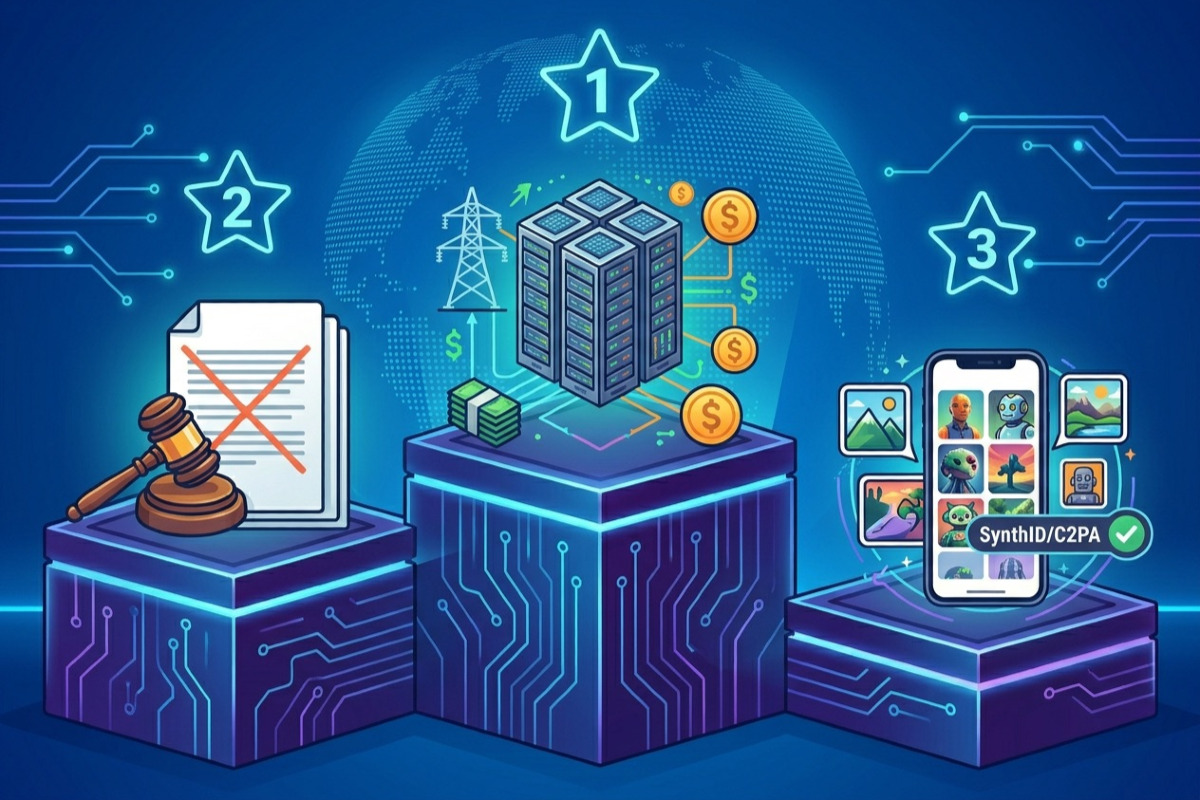
This week marks an important turning point in the evolution of artificial intelligence.
We are moving away from impressive standalone demos and entering a new phase:
AI as strategic infrastructure… and as a governance issue.
Three stories perfectly illustrate this shift.
1. OpenAI Raises $110 Billion: AI Becomes an Industrial Race
OpenAI announced a massive $110 billion funding round at a $730 billion pre-money valuation.
Investors include Amazon ($50B), NVIDIA ($30B), and SoftBank ($30B).
But the most structurally important part of the announcement may not be the amount itself.
OpenAI also confirmed a strategic partnership with Amazon:
- AWS will distribute its agent platform
- OpenAI is committing to approximately 2 gigawatts of Trainium capacity
Why This Matters
We are changing scale.
Competitive advantage in AI no longer depends solely on model quality.
It now depends on:
- Secured access to massive computing capacity
- Distribution through major cloud providers
- Infrastructure ready for production-grade agents
In short: AI has become a heavy industry.
📌 Source:
https://openai.com/index/scaling-ai-for-everyone/
2. Anthropic Rejects Certain Pentagon Terms: Governance Becomes Contractual
Anthropic publicly stated it would not allow its models to be used for:
- Mass domestic surveillance
- Fully autonomous weapons
According to the company, the U.S. government is pushing for “any lawful use” clauses—terms Anthropic refuses to accept.
Why This Is a Major Signal
We are entering a new phase of maturity.
AI governance is no longer confined to ethics charters or conference panels.
It is now embedded directly in commercial and government contracts.
AI providers will need to clarify:
- Where their red lines are
- How their guardrails are enforced
- How far they are willing to go to win a contract
AI is becoming as much a political and strategic issue as it is a technological one.
📌 Source:
https://www.anthropic.com/news/statement-department-of-war
3. Google Rolls Out Nano Banana 2: Image Generation Goes Mainstream
Google launched Nano Banana 2 (Gemini 3.1 Flash Image) and is integrating it broadly across its products: Gemini, Search, Ads, and more.
The rollout covers 141 new countries and territories.
Another key element: Google is strongly emphasizing provenance through SynthID and C2PA, noting that SynthID verification has already been used more than 20 million times.
Why This Is Strategic
Two things are happening simultaneously:
- Image generation is becoming a default layer within digital tools.
- Provenance and verification are becoming essential for adoption.
In other words:
Creation becomes instant.
Proof of origin becomes mandatory.
Provenance is no longer a technical detail—
it is a trust factor.
📌 Source:
https://blog.google/innovation-and-ai/technology/ai/nano-banana-2/
What These Three Stories Reveal
Together, they tell a clear story:
AI is entering its industrial and institutional phase.
We are seeing:
- Massive capital investments
- A gigawatt-scale compute race
- Contractual battles over usage
- Deep integration into everyday products
- The normalization of provenance standards
The debate is no longer just about “what AI can do.”
It is about:
- Who controls the infrastructure
- Who defines the rules
- Who assumes responsibility
A Question for Organizations
If you are a leader, entrepreneur, or technology executive, the question is no longer:
Should we use AI?
Instead, it is:
- Do we have access to the necessary infrastructure?
- Do we understand the contractual and regulatory implications?
- Are we ready for a world where content provenance is verifiable by default?
AI is not slowing down.
It is structuring itself.
And that structuring is changing the nature of competition itself.
